
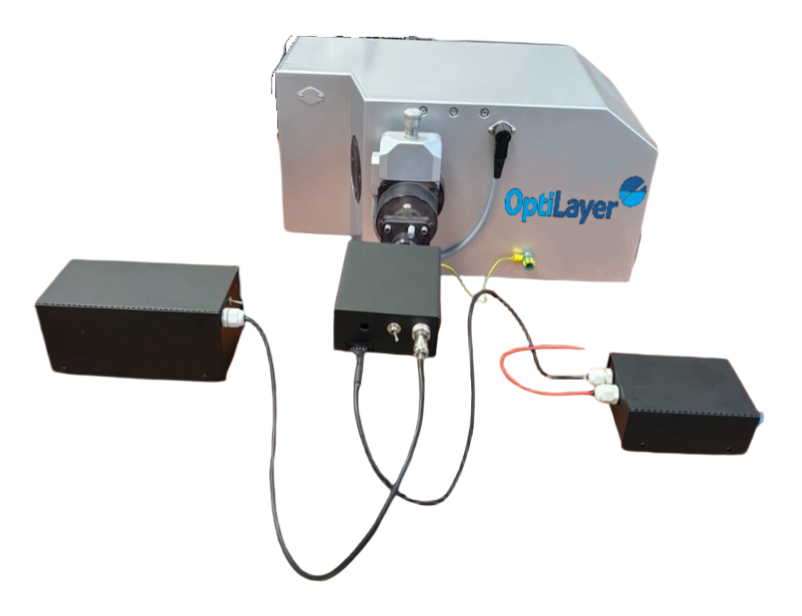
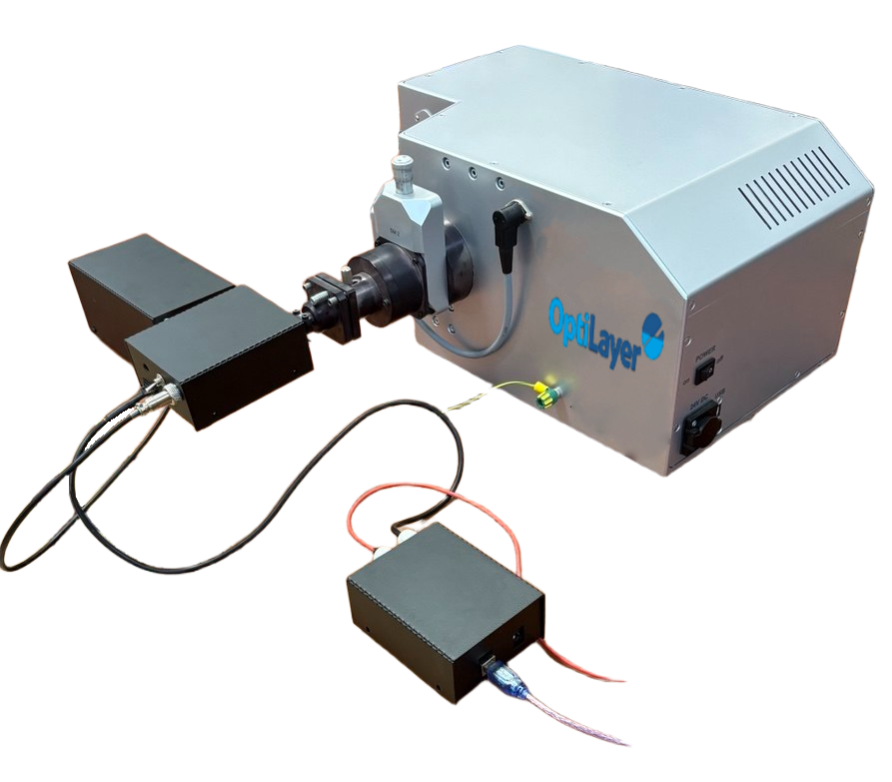
The measurement instrument built to work hand in hand with OptiLayer’s monitoring software.
For decades, OptiLayer has set the standard for the design, characterization, and monitoring of multilayer optical coatings. That expertise now extends to the measurement hardware itself. The OptiLayer Monochromator is a high-precision instrument engineered specifically for monochromatic monitoring of optical coating deposition — and designed to integrate directly with OL Monitor, closing the loop between measurement and layer-termination decisions.
In monochromatic monitoring, every layer-termination decision depends on detecting small changes in transmittance or reflectance as the coating grows. Electrical noise and measurement drift translate directly into thickness errors, and thickness errors translate into out-of-spec coatings. The OptiLayer Monochromator is built from the ground up to deliver a clean, stable, high-precision signal — so your monitoring strategy performs exactly as designed.
Broad spectral coverage in a single instrument. An operating range of 180–3600 nm spans deep ultraviolet, visible, near-infrared and mid-infrared — with an optimized Czerny–Turner scheme and a choice of up to four diffraction gratings on a motorized turret.
Ultra-low-noise electronics. A precision voltage regulator holds the power-supply noise to just 11–15 µV, and the spectral characteristic measurement error is only 0.01% — the clean, stable baseline that accurate monitoring demands.
High resolution and fine wavelength control. Resolution down to sub-0.15 nm, wavelength tuning repeatability to ±0.017 nm, and grating rotation steps as fine as 0.009 nm give you precise control over the measured signal.
Seamless OL Monitor integration. The monochromator works directly with OptiLayer’s OL Monitor over High-Speed USB, so measured data feeds straight into the software that drives your monitoring strategy — one connected workflow from measurement to layer termination.
| Optical scheme | Optimized Czerny–Turner, one optical input and two outputs |
| Spectral range (typical) | 190 – 3600 nm |
| Operating range | 180 – 3600 nm |
| Monochromator spectral bandwidth | 0.2 – 25.2 nm |
| F/number | 1 : 3.8 |
| Focal length | 284 mm |
| Flat field | 30 × 10 mm |
| Imaging | Optional; available on both output ports |
| Diffraction gratings | 50 × 50 × 10 mm; single grating or a turret with 4 gratings |
| Parameter | Grating 1 | Grating 2 | Grating 3 | Grating 4 |
|---|---|---|---|---|
| Grooves/mm | 1800 | 1200 | 600 | 300 |
| Reciprocal linear dispersion (avg.), nm/mm | 2.12 | 3.18 | 6.37 | 12.64 |
| Blaze wavelength, nm | 270 | 400 | 750 | 2000 |
| Spectral range, nm | 190–540 | 265–800 | 500–1500 | 1330–3600 |
| Multichannel array bandpass (avg.), nm | 51 | 76 | 150 | 160 |
| Resolution (avg.), nm | <0.15 | <0.22 | <0.45 | <0.94 |
| Wavelength tuning accuracy, nm | ±0.067 | ±0.1 | ±0.2 | ±0.4 |
| Wavelength tuning repeatability, nm | ±0.017 | ±0.025 | ±0.05 | ±0.1 |
| Step of grating rotation, nm | 0.009 | 0.013 | 0.026 | 0.05 |
| Scanning rate, nm/s | 16.7 | 25 | 50 | 100 |
| Entrance / exit slits | Automatic and manual adjustment |
| Slit width | 0 – 2 mm |
| Slit height | 12 mm |
| Parallelism | ±1 µm |
| Micrometer reading accuracy | ±1 µm |
| Step size | 0.001953125 mm |
| Precision | ±1 µm |
| Filter wheel | Automatic switching |
| Max number of filters | 6 |
| Standard number of filters | 5 |
| Filter size | 20 mm |
| Light aperture | 18 mm |
| Integrated shutter | Program-controlled; for dark-signal measurement |
| Power supply | Precision voltage regulator, noise level 11–15 µV |
| Amplifier power supply | 24 V |
| Spectral characteristic measurement error | 0.01% |
| Computer interface | High-Speed USB |
| Dimensions | 410 × 252 × 213 mm |
| Weight | 23.5 kg |
| Software integration | OL Monitor |
Combined with OL Monitor and the OptiLayer software suite, the monochromator gives coating engineers a single, coherent toolchain: design the coating, develop the monitoring strategy, and run production monitoring on hardware built to the same exacting standard. Fewer sources of error, tighter control, and better yields on your most demanding coatings.
To discuss how the OptiLayer Monochromator fits your deposition process, or to request a quotation, contact us at info@optilayer.com. Our team will be glad to help you configure the right solution for your application.

OptiLayer provides user-friendly interface and a variety of examples allowing even a beginner to effectively start to design and characterize optical coatings. Read more…

Comprehensive manual in PDF format and e-mail support help you at each step of your work with OptiLayer.

If you are already an experienced user, OptiLayer gives your almost unlimited opportunities in solving all problems arising in design-production chain. Visit our publications page.
Look our video examples at YouTube
OptiLayer videos are available here:
Overview of Design/Analysis options of OptiLayer and overview of Characterization/Reverse Engineering options.
The videos were presented at the joint Agilent/OptiLayer webinar.